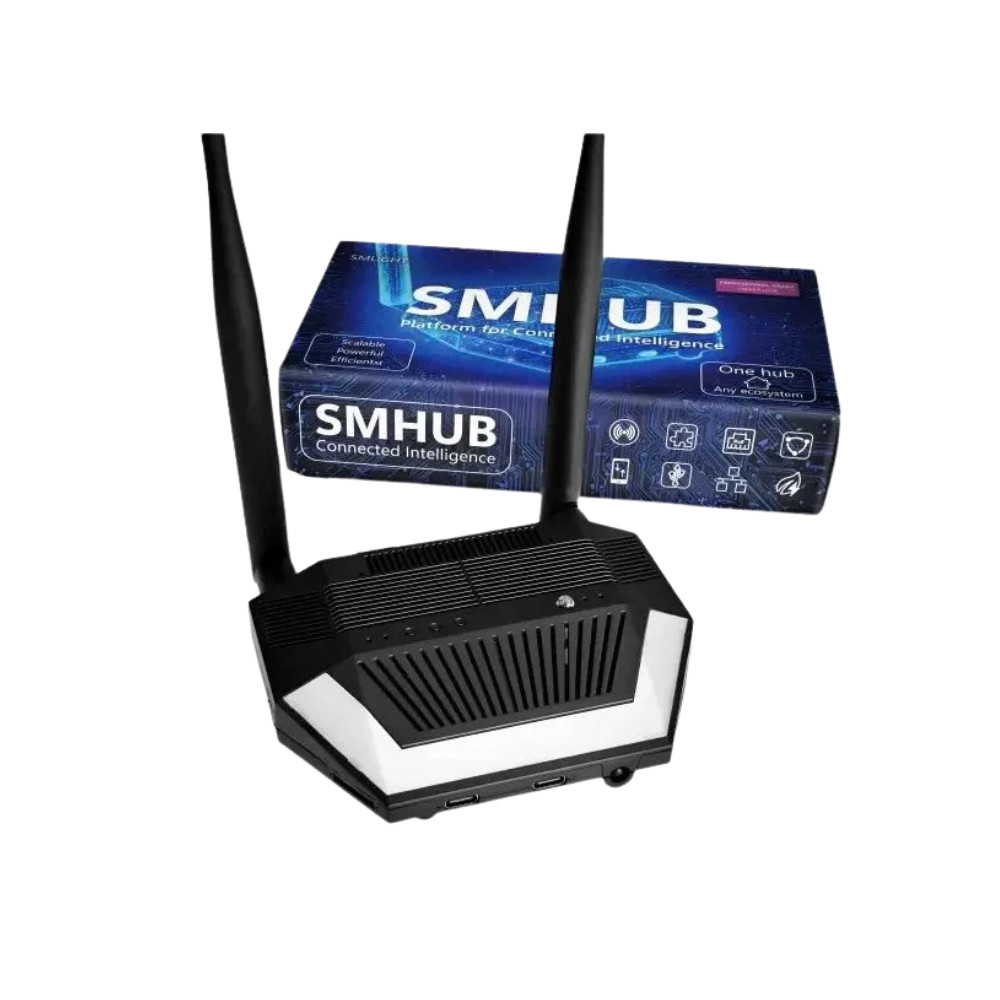
SMLIGHT SMHUB Essential – Zigbee, Thread, Wi-Fi, Bluetooth, IR, Ethernet, 2*USB-C, Matter (CC2652P+EFR32MG21)
SMLIGHT SMHUB Essential is a Linux-based smart home hub designed for local operation, featuring two built-in Zigbee/Thread radios.
All product prices include VAT.
Note: Guest users see prices with estimated VAT amount. The payable price with your local value-added tax amount will be calculated based on your shipping address, added at checkout or set in your user profile.

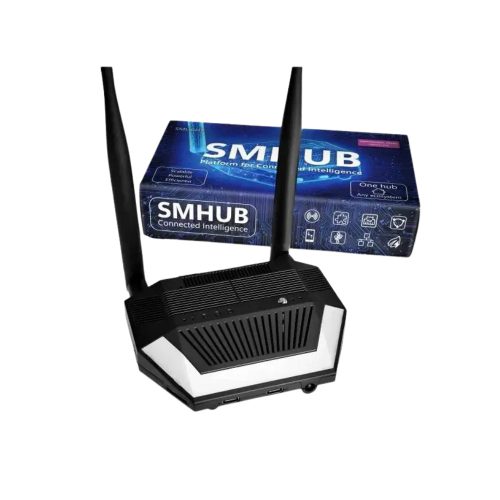


SMLIGHT SMHUB Essential is a Linux-based smart home hub designed for local operation, featuring two built-in Zigbee/Thread radios. The device is not simply a network Zigbee coordinator: its own SMHUB-OS operating system can directly run services such as Zigbee2MQTT, the Mosquitto MQTT broker, Node-RED, and Matterbridge, allowing it to be used either as a standalone smart home hub or as a network gateway for Home Assistant and other systems.
The Essential version features two independent 2.4 GHz radios: a Texas Instruments CC2652P and a Silicon Labs EFR32MG21 system-on-chip. This allows, for example, two separate Zigbee networks to be operated from a single hub, or one radio to be used as a Zigbee coordinator while the EFR32MG21 is used as a Thread radio. According to the manufacturer's current documentation, the EFR32MG21 radio is supported in Thread mode; Thread support for the CC26xx radio is still under development.
The SMHUB Essential is equipped with 512 MB of RAM, 8 GB of built-in eMMC storage, and supports microSD expansion up to 2 TB. It can connect to the network via 10/100 Mbps Ethernet or dual-band 2.4/5 GHz Wi-Fi 6, and Bluetooth 5.0 is also available. Thanks to its modular design, it can be expanded with optional Z-Wave, 4G/LTE, and IEEE 802.3af PoE modules.
About SMLIGHT
SMLIGHT primarily develops network-based Zigbee and Thread coordinators, USB radio adapters, gateways, WLED controllers, and other DIY smart home accessories for open smart home systems. Its product range includes solutions based on both Texas Instruments and Silicon Labs radio chipsets.
A significant number of SMLIGHT devices are designed for Home Assistant, Zigbee2MQTT, ZHA, OpenThread, and other open-source systems. The products are primarily intended for users and system integrators building their own locally operated smart home systems. In addition to the manufacturer's documentation, community documentation from the related open-source projects also plays an important role in technical support.
Key Product Features
- Linux-based smart home hub: SMHUB-OS runs smart home services directly on the device, eliminating the need for a separate computer to run applications such as Zigbee2MQTT, Mosquitto, or Node-RED.
- Two independent radios: The Essential version includes one Texas Instruments CC2652P and one Silicon Labs EFR32MG21 radio, which can be used to manage separate networks.
- Standalone operation: With Zigbee2MQTT, an MQTT broker, and Node-RED, a locally operated Zigbee system and automations can be created without Home Assistant or another external smart home hub.
- Matterbridge: Compatible Zigbee devices managed by Zigbee2MQTT can be exposed to Matter systems through Matterbridge.
- Network connectivity: 10/100 Mbps Ethernet and dual-band Wi-Fi 6 connectivity are available.
- Expandable storage: In addition to 8 GB of built-in eMMC storage, microSD cards of up to 2 TB can be used.
- Modular expandability: Optional Z-Wave, 4G/LTE, and PoE modules can add further communication and power supply options to the system.
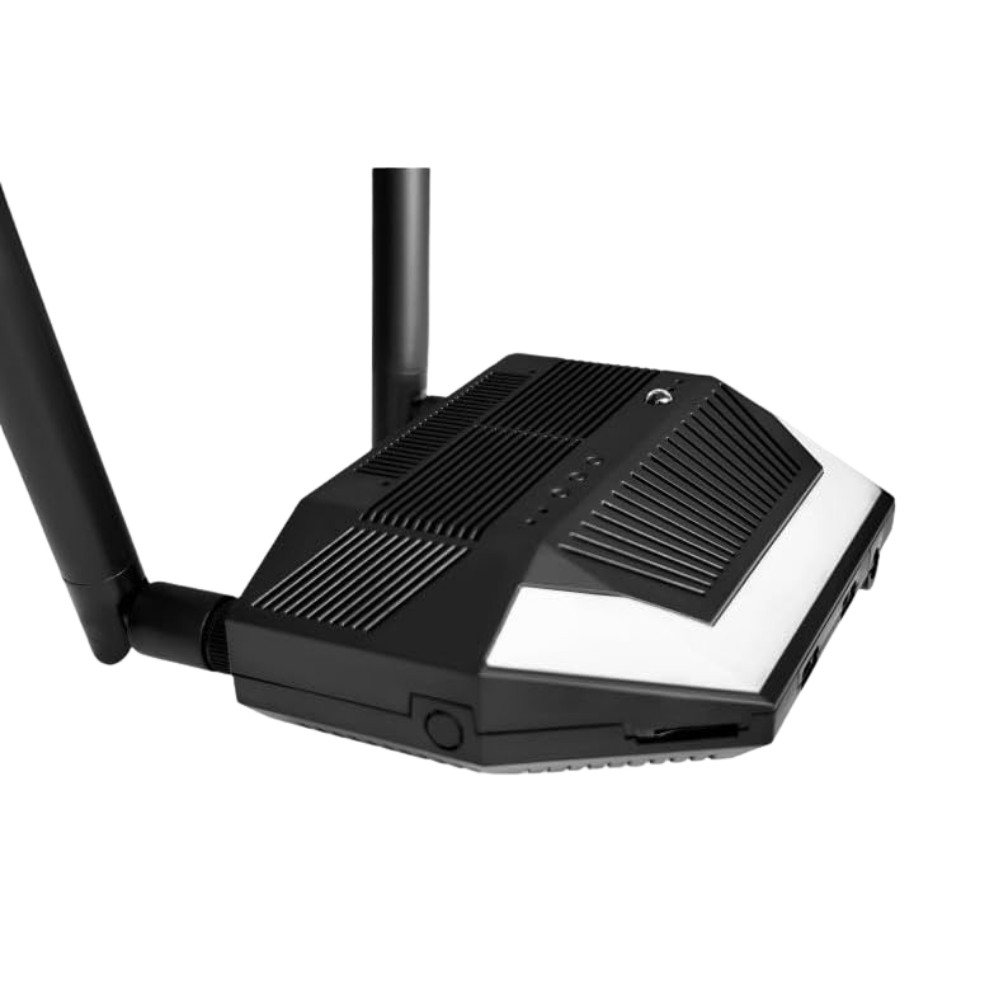
- Passive cooling: Fanless design for continuous 24/7 operation.
Smart Home Protocols and Platform Compatibility
- Zigbee: The Essential's two separate radios can be used to manage Zigbee networks. Since the CC2652P and EFR32MG21 are independent radios, up to two separate Zigbee networks can be operated.
- Thread: According to the manufacturer's current documentation, the EFR32MG21 radio can be used with OpenThread firmware for Thread networking. Thread support for the CC26xx radio is currently not yet available in the SMHUB system.
- OpenThread Border Router: The OpenThread application can run directly on the SMHUB, with the EFR32MG21 used as the Thread radio. The system can also be connected to a Home Assistant Matter over Thread environment.
- Matterbridge: Can run locally on the SMHUB. Compatible Zigbee devices managed by Zigbee2MQTT can be exposed to Matter-compatible systems through a Matter Bridge.
- Apple Home: Compatible Zigbee devices can be exposed to Apple Home using Matterbridge.
- Google Home: Compatible Zigbee devices can also be used in Google Home through Matterbridge.
- Amazon Alexa: Compatible Zigbee devices can also be bridged to the Alexa Matter ecosystem through Matterbridge.
- Home Assistant: The SMHUB can connect to Home Assistant over the network. Zigbee2MQTT and MQTT services can run directly on the SMHUB; Home Assistant itself does not run on the SMHUB.
- Zigbee2MQTT: Can run directly on the SMHUB Linux system, eliminating the need for a separate Zigbee2MQTT server.
- MQTT: The Mosquitto MQTT broker can run directly on the SMHUB. Home Assistant, OpenHAB, and other compatible systems can connect via MQTT.
- OpenHAB: The SMHUB's network services and MQTT interface can also be used with OpenHAB.
- Z-Wave: Not included in the standard SMHUB Essential configuration. The optional Z-Wave module adds a 700/800 Series Z-Wave controller with Z-Wave Long Range and S2 support.
- Z-Wave JS: When using the optional Z-Wave module, Z-Wave JS UI can run directly on the SMHUB.
- Bluetooth: Equipped with a built-in Bluetooth 5.0 radio.
Smart Features
- Zigbee2MQTT: Zigbee device pairing, configuration, and control can be handled directly by the Zigbee2MQTT application running on the SMHUB.
- Two separate Zigbee networks: The two built-in radios can be used to create two independent Zigbee networks.
- Simultaneous Zigbee and Thread operation: One radio can be assigned to a Zigbee network while the EFR32MG21 is used for a Thread network.
- Local automations: Node-RED running directly on the SMHUB can be used to create local automations based on Zigbee2MQTT, MQTT, scheduling, and other events.
- MQTT broker: Mosquitto can run directly on the device, eliminating the need for a separate MQTT broker server.
- Matter Bridge: Matterbridge can expose compatible Zigbee devices to Matter ecosystems.
- OpenThread Border Router: With the OpenThread application, the SMHUB can be used as a Thread Border Router in Matter over Thread environments.
- Web interface: SMHUB-OS settings, applications, and radios can be managed over the local network through a web interface.
- OTA updates: The SMHUB system and installed applications can be updated through the web interface.
- WireGuard: WireGuard VPN can run directly on the device for encrypted remote network access.
- Tailscale: The system can also be accessed remotely using Tailscale.
- Node.js: Node.js applications can run directly on the SMHUB Linux system.
- Infrared control: Equipped with a built-in infrared transmitter and receiver for handling signals from compatible IR remote controls.
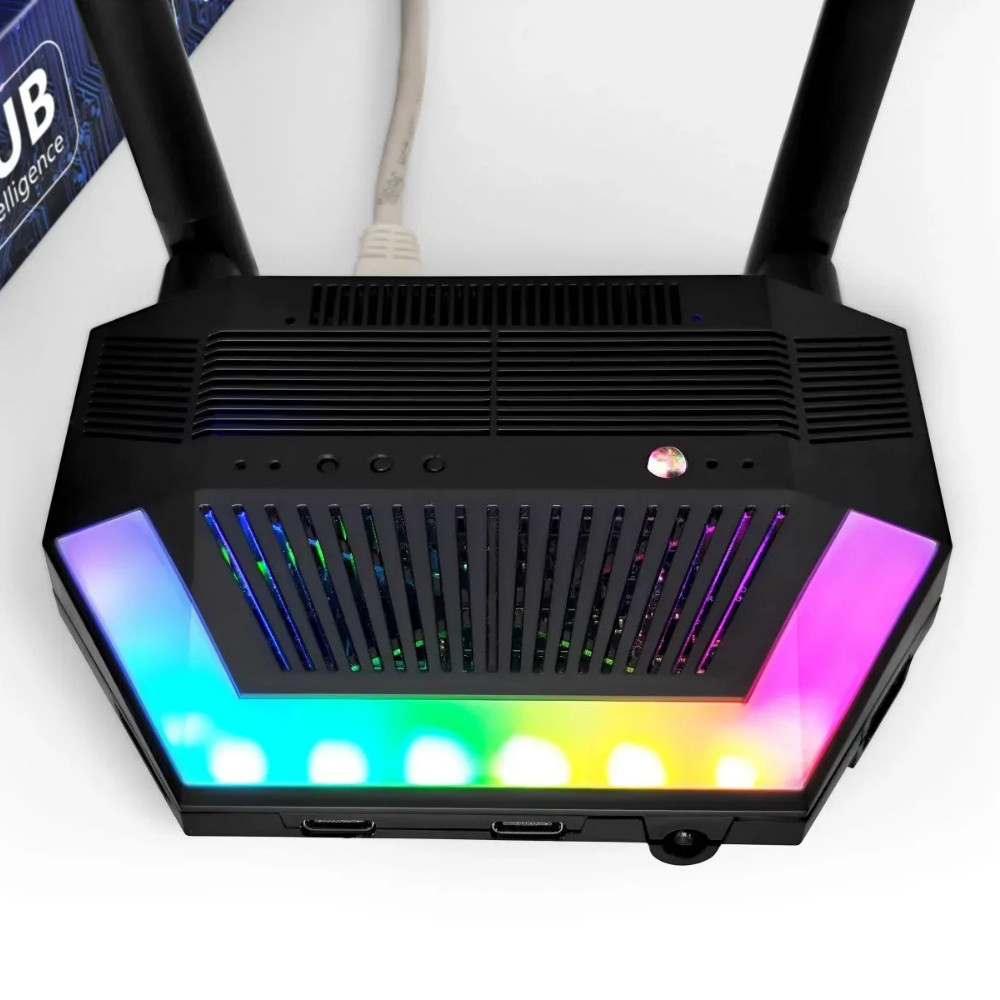
- Ambilight status indication: 12 addressable WS2812B RGB LEDs are available for visual status indication.
- Audible indication: Includes a built-in buzzer.
Power Supply and Network Connections
- USB-C power supply: The standard configuration can be powered through USB-C.
- PoE: The separately available PoE module enables IEEE 802.3af Power over Ethernet, allowing a single Ethernet cable to carry both network data and power.
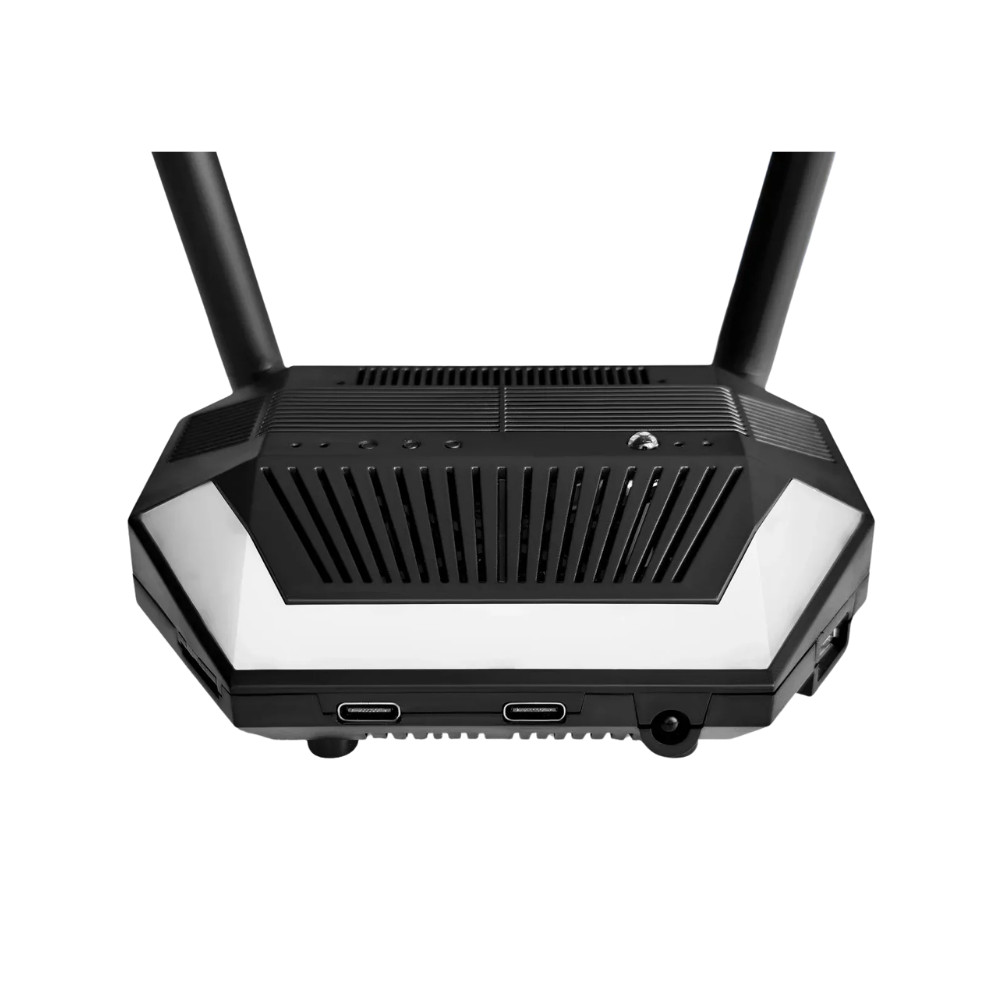
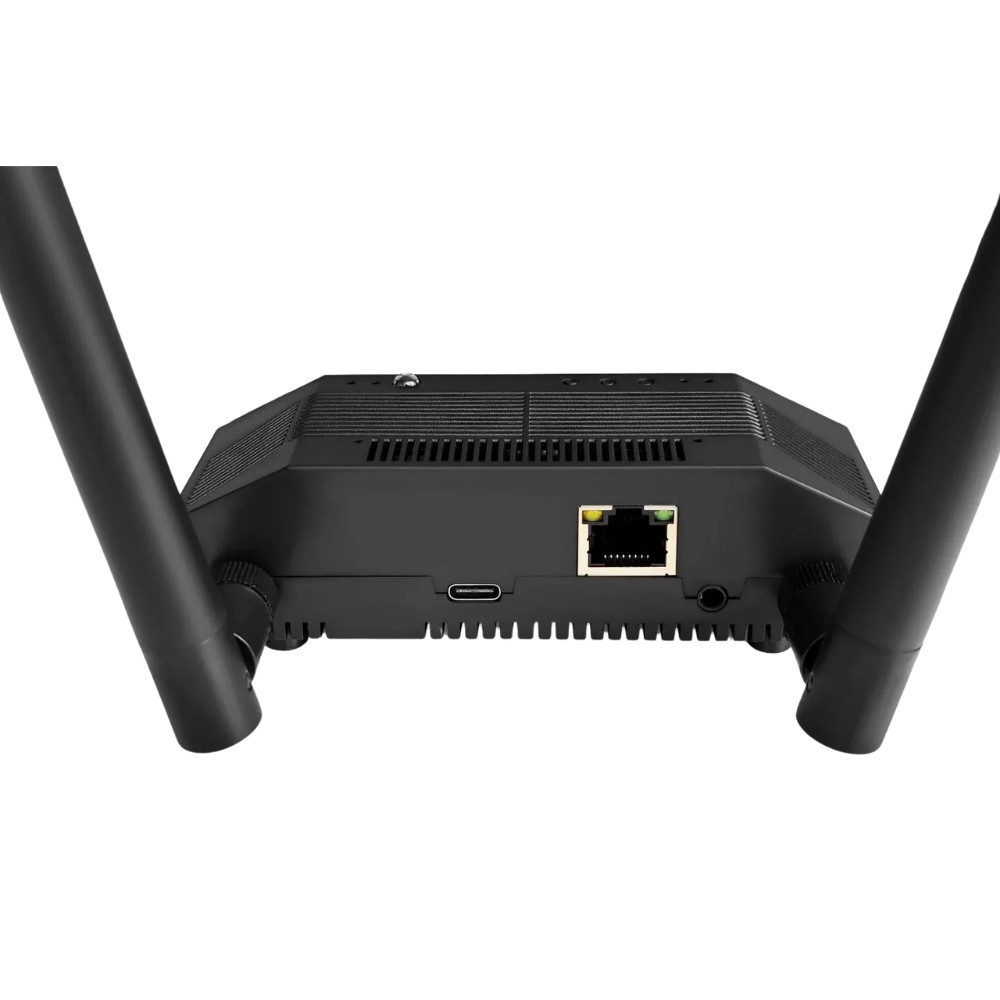
- Ethernet: Equipped with one RJ45 10/100 Mbps Ethernet port.
- Wi-Fi: Wi-Fi 6 connectivity for both 2.4 GHz and 5 GHz networks.
- Bluetooth: Built-in Bluetooth 5.0 connectivity.
- USB-A: Includes one USB-A port.
- USB-C downstream: Two USB-C downstream ports are available for peripherals.
- USB-C power/upstream: A dedicated USB-C connector is provided for power and upstream connectivity.
- DIY interfaces: Includes UART, I²C, SPI, and GPIO connectivity options.
- 4G/LTE: The separately available module adds LTE Cat-1 mobile network connectivity, GSM/EDGE fallback, and a nano-SIM slot.
Technical Specifications
- Product name: SMLIGHT SMHUB Essential
- Product type: Linux-based modular smart home hub
- Processor: 2 separate C906 RISC-V cores, 1 GHz for the Linux system and 700 MHz for the RTOS system
- NPU: 0.5 TOPS INT8
- RAM: 512 MB
- Built-in storage: 8 GB eMMC
- Memory card: microSD, up to 2 TB
- Operating system: Linux-based SMHUB-OS
- Primary Zigbee radio: Texas Instruments CC2652P
- Secondary Zigbee/Thread radio: Silicon Labs EFR32MG21
- Wi-Fi: Wi-Fi 6, 2.4 GHz and 5 GHz
- Bluetooth: Bluetooth 5.0
- Ethernet: 1 × RJ45, 10/100 Mbps
- USB: 1 × USB-A, 2 × USB-C downstream, and 1 × USB-C power/upstream
- DIY interfaces: UART, I²C, SPI, and GPIO
- Zigbee antenna: External antenna
- Thread antenna: External antenna
- Wi-Fi antenna: Internal antenna with IPEX connector, expandable
- Bluetooth antenna: Internal antenna with IPEX connector, expandable
- Infrared interface: Transmitter and receiver
- Buzzer: Built-in
- RGB status indication: 12 × WS2812B addressable RGB LEDs
- Audio output: 3.5 mm
- Controls: 3 buttons and 4 service LEDs
- Operating temperature: 0–50 °C
- Cooling: Passive, fanless
- Firmware update: OTA
Additional Features
- Optional Z-Wave: Z-Wave radio functionality is not included in the standard Essential configuration and requires a separate expansion module.
- Optional 4G/LTE: Mobile network connectivity can be added with a separate expansion module.
- Optional PoE: IEEE 802.3af PoE functionality requires a separate PoE module.
- Local operation: Core Zigbee, MQTT, and automation services run locally, so they do not require a manufacturer's cloud service to operate.
- DIY and system integrator use: Due to its Linux-based system, multiple radios, installable services, and UART/I²C/SPI/GPIO interfaces, the device is primarily intended for users and system integrators experienced with open smart home systems.